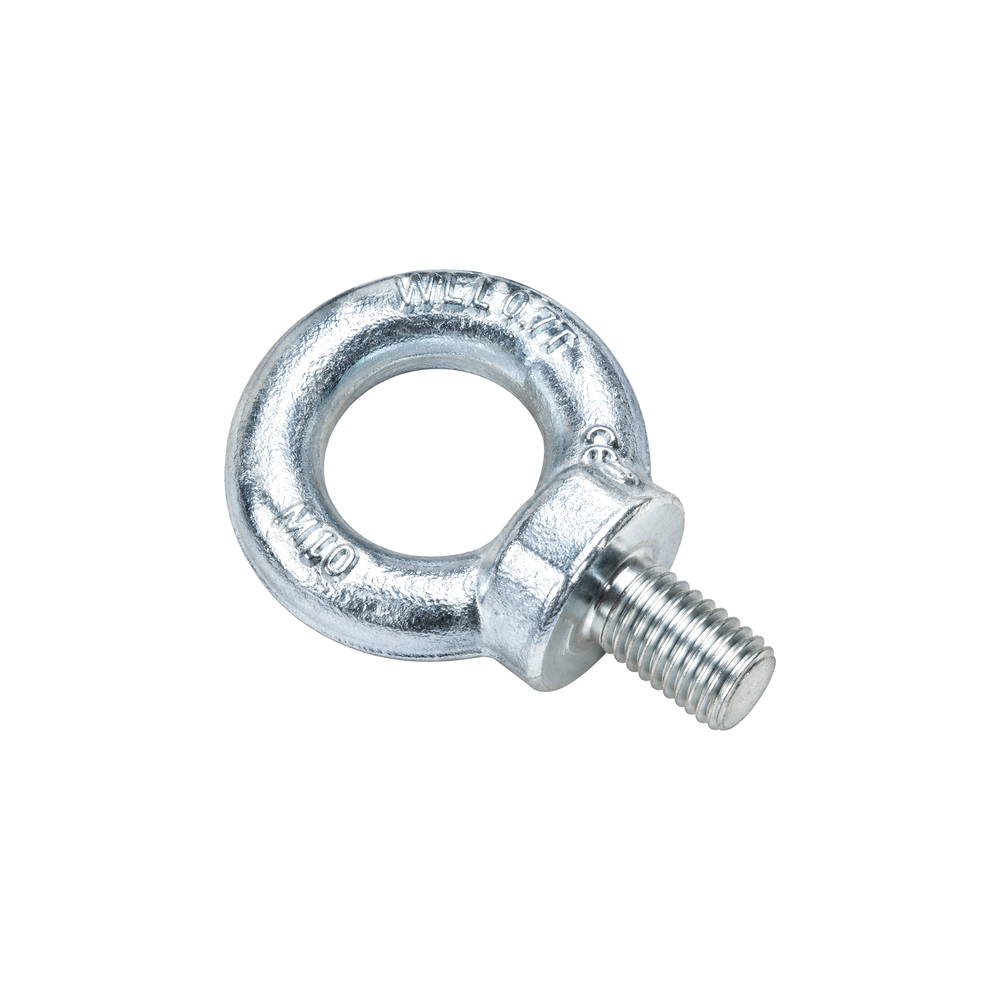
Eye bolts and eye nuts provide a threaded lifting or anchoring point. Sizes and load ratings are stated per item; select the pattern to match the direction of the pull.
Product line
Models in this line
Every model in this line has its own catalogue photo, dimension table and drawing. Select a model to see its full detail below.
Eye Bolt DIN 580
Model 01 / 06
Eye Bolt DIN 580
MaterialSteel Q235B
SurfaceElectro-galvanized
Size rangeM6 – M100
Specification table
Dimensional drawing — shows the dimension symbols used in the table.
Size
d1
d2
D
h
k
l
Weight
WLL
mm
mm
mm
mm
mm
mm
mm
kg/pc
t
M6
20
36
20
38
8
13
0.06
0.08
M8
20
36
20
38
8
13
0.06
0.14
M10
25
45
25
47
10
17
0.1
0.23
M12
30
54
30
55
12
20
0.18
0.34
M14
30
54
30
55
12
20
0.19
0.5
M16
35
63
35
64
14
27
0.29
0.7
M18
35
63
35
64
14
27
0.29
0.7
M20
40
72
40
73
16
30
0.44
1.2
M22
40
72
40
73
16
30
0.44
1.2
M24
50
90
50
90
21
35
0.9
1.8
M27
50
90
50
90
21
35
0.88
2.5
M30
60
109
65
114
25
44
1.63
3.6
M33
60
109
65
114
25
44
1.63
4.2
M36
70
126
74
130
27
56
2.5
5.1
M42
80
143
83
152
34
65
4.1
7
M48
90
160
99
160
40
71
6.52
8.6
M56
98
182
109
188
42
85
8.7
11.5
M64
108
200
120
210
50
95
12.5
16
M72
140
255
148
305
62
105
22.2
20
M80
156
295
166
310
68
120
33.7
28
M100
175
320
190
320
74
140
43.7
40
Catalogue values. Dimensions in mm unless the size column shows an inch value. Confirm the exact size, material and rating before ordering.
Eye Nut DIN 582
Model 02 / 06
Eye Nut DIN 582
MaterialSteel Q235B
SurfaceElectro-galvanized
Size rangeM6 – M56
Specification table
Dimensional drawing — shows the dimension symbols used in the table.
Size
d1
d2
D
h
k
Weight
WLL
mm
mm
mm
mm
mm
mm
kg/pc
t
M6
20
36
20
37
8
0.06
0.08
M8
20
36
20
37
8
0.05
0.14
M10
25
45
25
45
10
0.1
0.23
M12
30
54
30
53
12
0.16
0.34
M14
30
54
30
53
12
0.16
0.5
M16
35
63
35
62
14
0.24
0.7
M18
35
63
35
62
14
0.24
0.93
M20
40
72
40
71
16
0.37
1.2
M22
40
72
40
71
16
0.36
1.5
M24
50
90
50
92
20
0.74
1.8
M27
50
90
50
92
20
0.72
2.5
M30
60
109
65
114
25
1.36
3.2
M33
60
109
65
114
25
1.3
3.2
M36
70
125
75
134
28
2.18
4.6
M42
80
143
85
153
33
3.11
6.3
M48
88
164
100
165
39
5.06
8.6
M56
98
185
110
185
44
6.53
11.5
Catalogue values. Dimensions in mm unless the size column shows an inch value. Confirm the exact size, material and rating before ordering.
High Tensile Eye Bolt
Model 03 / 06
High Tensile Eye Bolt
MaterialSteel C45E
SurfaceHot-dip galvanized
Size rangeM10 – M24
Specification table
Dimensional drawing — shows the dimension symbols used in the table.
Size
d1
d2
D
h
k
l
Weight
WLL
mm
mm
mm
mm
mm
mm
mm
kg/pc
t
M10
25
42
18
45
8
33
0.07
0.64
M12
30
50
24
55
10
38
0.13
0.9
M16
34
61
31
67
13.5
46
0.26
1.6
M20
37
70
35
76
16.5
55
0.44
2.5
M24
51
96
47
105
23
63
1.04
4
Catalogue values. Dimensions in mm unless the size column shows an inch value. Confirm the exact size, material and rating before ordering.
High Tensile Eye Nut
Model 04 / 06
High Tensile Eye Nut
MaterialSteel C45E
SurfaceHot-dip galvanized
Size rangeM8 – M24
Specification table
Dimensional drawing — shows the dimension symbols used in the table.
Size
d1
d2
D
h
k
l
Weight
WLL
mm
mm
mm
mm
mm
mm
mm
kg/pc
t
M8
18
32
17
25
7
43
0.04
0.25
M10
24
41
19
31
8
53
0.06
0.56
M12
31
52
25
38
10
65
0.13
0.9
M16
36
63
31
50
13.5
82
0.25
1.6
M20
42
76
35
60
17
100
0.45
2.3
M24
57
95
40
78
22
127
1
4
Catalogue values. Dimensions in mm unless the size column shows an inch value. Confirm the exact size, material and rating before ordering.
High Tensile Shoulder Eye Bolt
Model 05 / 06
High Tensile Shoulder Eye Bolt
MaterialSteel C45E
SurfaceHot-dip galvanized
Size rangeM8x60mm – M24x150mm
Specification table
Dimensional drawing — shows the dimension symbols used in the table.
Size
Thread i
d1
d
e
h
k
l
Weight
WLL
mm
mm
mm
mm
mm
mm
mm
mm
kg/pc
t
M8x60mm
M8
29
15
39
34
7
140
0.07
0.4
M10x65mm
M10
36
18
39
40
9
102
0.09
0.64
M12x85mm
M12
46
25
45
50
10
130
0.17
0.9
M16x100mm
M16
58
32
52
65
13
163
0.35
1.6
M20x115mm
M20
69
38
52
77
16
198
0.64
2.5
M24x150mm
M24
94
50
78
102
21
260
1.41
4
Catalogue values. Dimensions in mm unless the size column shows an inch value. Confirm the exact size, material and rating before ordering.
Screw Eye (wood Thread)
Model 06 / 06
Screw Eye (wood Thread)
MaterialSteel C45E
SurfaceHot-dip galvanized
Size range55mm – 100mm
Specification table
Dimensional drawing — shows the dimension symbols used in the table.
Size
i
d1
d
e
h
k
l
Weight
WLL
mm
mm
mm
mm
mm
mm
mm
mm
kg/pc
t
55mm
6.5
26
13
40
29
6
84
0.03
0.16
60mm
8.5
30
16
47
34
7
94
0.05
0.4
70mm
10
36
18
49
38
9
107
0.07
0.64
85mm
13
46
26
57
52
10
132
0.16
0.9
100mm
16
57
31
76
64
13
165
0.32
1.6
Catalogue values. Dimensions in mm unless the size column shows an inch value. Confirm the exact size, material and rating before ordering.
Technical data
Rated load by direction of loading
The permitted load depends strongly on the direction in which the load is applied. Three cases are defined:
F1Axial load
Load acting along the axis of the thread. This is the highest rated load and corresponds to the WLL marked on the eye bolt.
F2Angled load, max. 45 degrees
Applies when the angle between each sling branch and the vertical does not exceed 45 degrees.
F3Lateral load, max. 45 degrees
Applies when the load acts in parallel to the plane of the eye. Lateral loading of eye bolts should be avoided wherever possible.
Do not use under shear tension
Mandatory conditions of use (per DIN 580:2018-04)
The eye bolt must be fully screwed in, so that there is firm contact between the two mating faces.
The counter thread must be of an equal length, and the base material of an equal strength to that of the bolt.
Tapped holes must have a threaded length sufficient to ensure the shank is fully engaged and the collar fully seated (see DIN 76-1).
With clearance holes, an eye bolt / nut assembly shall be used. The nut should be of a size equal to 0.8 x d and be tightened, with a washer used where thread length permits.
Eye bolts must not be used under shear tension.
Before use, each eye bolt should be checked for correct seating and apparent damage, such as corrosion or deformation. Deformed eye bolts must be discarded.
Eye bolts and nuts should not be colour marked in use, and particularly not marked in red, so they cannot be mistaken for high-strength fixing points.
Source: mounting instruction / user information according to DIN 580:2018-04.
Marking required by the standard
DIN 580:2018-04 requires eye bolts to be permanently marked by embossing with:
the manufacturer trademark,
the symbol denoting the material grade, for example C15E or A2,
the lifting capacity in the axial direction, given as the working load limit (WLL) in kg,
an arrow indicating the axial direction.
Space shall also be provided for any marking required by statutory regulations, such as CE marking.
Declaration of intended use
Eye bolts intended for lifting loads are machinery components and, for the European market, carry their own conformity requirements including operating instructions supplied with the product. Our standard eye bolts and eye nuts without CE marking on the body are supplied for general securing, anchoring and lashing purposes, not as rated lifting points for overhead lifting. Please state the intended application in your enquiry so that the correct specification, marking and documentation can be offered.
Related pages
These pages cover the same job from a different angle.
Components in this group are produced by the route that suits the part — forging for load-bearing items, forming or machining for the rest.
Threads, bores and bearing surfaces are machined and gauged.
Assemblies are put together and checked for movement where they have moving parts.
Surface treatment is applied, then a final visual and dimensional check before packing.
What to check on receipt
The part matches the drawing or sample it was ordered against.
Threads and bores are clean and within tolerance.
No cracks, distortion or sharp edges at the load-bearing points.
FAQ
FAQ
Can an eye bolt be used for angled lifting?
Capacity reduces as the angle of pull moves away from the axis of the shank, and some standards do not permit angled loading at all. Tell us the angle and we will confirm what applies.
What is the difference between DIN 580 and DIN 582?
DIN 580 is an eye bolt, screwed into a tapped hole. DIN 582 is an eye nut, screwed onto an existing stud or bolt.
What do F1, F2 and F3 mean on a DIN 580 eye bolt?
They are the maximum loads for different directions of pull. F1 is a pull in the plane of the eye; F2 and F3 apply as the pull moves away from that plane, and capacity drops sharply as it does. For M20, for example, published values are F1 12,000 N, F2 8,600 N and F3 6,000 N.
Are those values your tested figures?
No. They are the values the DIN standard specifies for the size, taken from the standard sheets published by Ganter Norm, JW Winco, Mädler and TraceParts — cross-checked, all four agree. Actual capacity for our production is as stated in the factory test report and as confirmed in the order.
How must an eye bolt be fitted?
It must be screwed in fully so that the two mating faces meet. Both threads must be of equal length and the base material of equal strength to the bolt. The operating instructions supplied with the eye bolt give the full guidance.
Do you stock stainless steel eye bolts?
We supply eye bolts and eye nuts to DIN 580 and DIN 582 in carbon steel, and can supply stainless on request. Tell us the grade and size you need.
Sources: Crosby clip instructions; Wire Rope Technology Aachen and H-Lift documentation on DIN 741 and EN 13411-5; Ganter Norm, JW Winco and Mädler DIN 580 / DIN 582 standard sheets; published shackle selection guidance from H-Lift, AIMS Industrial and Hijskampioen.