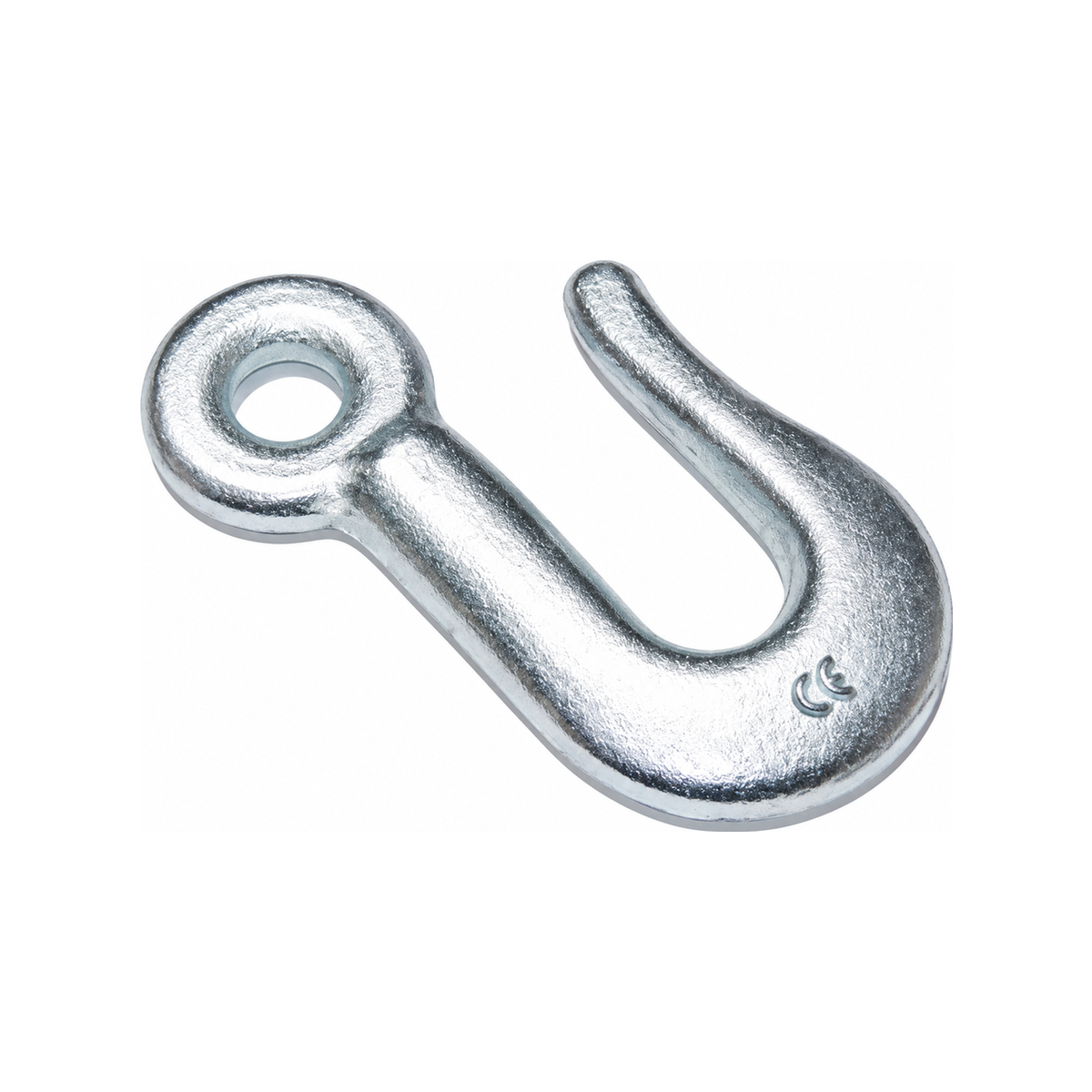
A forged eye hook combines a closed eye for attachment with a load bearing hook body. The DIN 689 type covers 250 to 6300 kg working load; the 320 and 322 series are offered in carbon steel (C) and alloy steel (A) with a spring latch.
Product line
Models in this line
Every model in this line has its own catalogue photo, dimension table and drawing. Select a model to see its full detail below.
Check the material marking: C is carbon steel, A is alloy steel. The alloy version is not simply a heavier carbon hook — it is made for higher toughness at low temperatures.
Size by working load, and keep a safety factor of at least 4:1. The latch protects the hook opening; it is not a substitute for the rating.
For a load that may swing or rotate freely, use the swivel 322 series so the eye does not wind up the sling.
Applications
Wire rope sling eyesLashing and cargo restraintTowing and pullingConstruction and riggingAgricultural handlingMarine and dock work
Safety & use notes
Never exceed the working load limit, and never stand under a suspended load.
The spring latch keeps the hook opening closed in normal use. It must snap fully shut and must not be bent, wired open or blocked.
Hooks are the most abused item in rigging. Reject any hook that has been overloaded, bent, galled, or has a worn or stretched throat.
The agricultural hook is not a lifting hook and carries no rated load.
Model types, related standards and manufacturing
Types & standards
Eye hook DIN 689Forged quenched and tempered carbon steel eye hook, 250 to 6300 kg working load, safety factor 4:1.
Eye hook with latch 320C / 320ACarbon steel (C) and alloy steel (A) versions of the same nominal size, with a spring safety latch across the hook opening.
Swivel eye hook 322C / 322AAs the 320 series but with a rotating eye, so the load can swing without twisting the rope.
Agricultural hookA light hook for farm and non-lifting duties. No rated load is declared for this type.
Manufacturing
How it is made
The hook blank is forged so the grain flow follows the shape of the hook — this is why forging, not casting, is the normal route for load-bearing hooks.
The eye or shank is formed and, where the pattern requires it, machined for a thread or a shank fitting.
Heat treatment is applied to reach the required mechanical properties, then the hook is proof tested and sampled for destructive testing according to the applicable standard.
Surface treatment is applied and, where the pattern includes a latch, the latch is fitted and checked for free movement and full closure.
What to check on receipt
The throat has not opened out beyond the limit in the standard, and the hook has no twist.
No cracks — particularly at the throat and at the point where the shank meets the eye.
Where a latch is fitted, it closes fully and springs back.
Marking is legible: size, working load limit, manufacturer and traceability code.
FAQ
What is the difference between 320C and 320A?
C denotes carbon steel and A denotes alloy steel. They are made to the same nominal size but the alloy version is rated for higher loads and better performance at low temperature. The size columns in the table show the equivalent size of each material.
Does the safety latch make the hook safe for lifting?
No. The latch only keeps the opening closed when there is no load. The lifting capacity comes from the forged body and the rated load, not from the latch.
Cookies on newbas.comWe use strictly necessary cookies to run this site. With your consent only, Google Analytics 4 helps us understand how it is used. No tracking, no advertising.